Modernizing Aircraft Interiors Through Advanced Additive Manufacturing
In aviation MRO (Maintenance, Repair, and Overhaul), operators navigate complex, tightly regulated maintenance cycles. Every upgrade must be precise, and every extra day an aircraft spends on the ground increases operational costs and disrupts flight schedules.
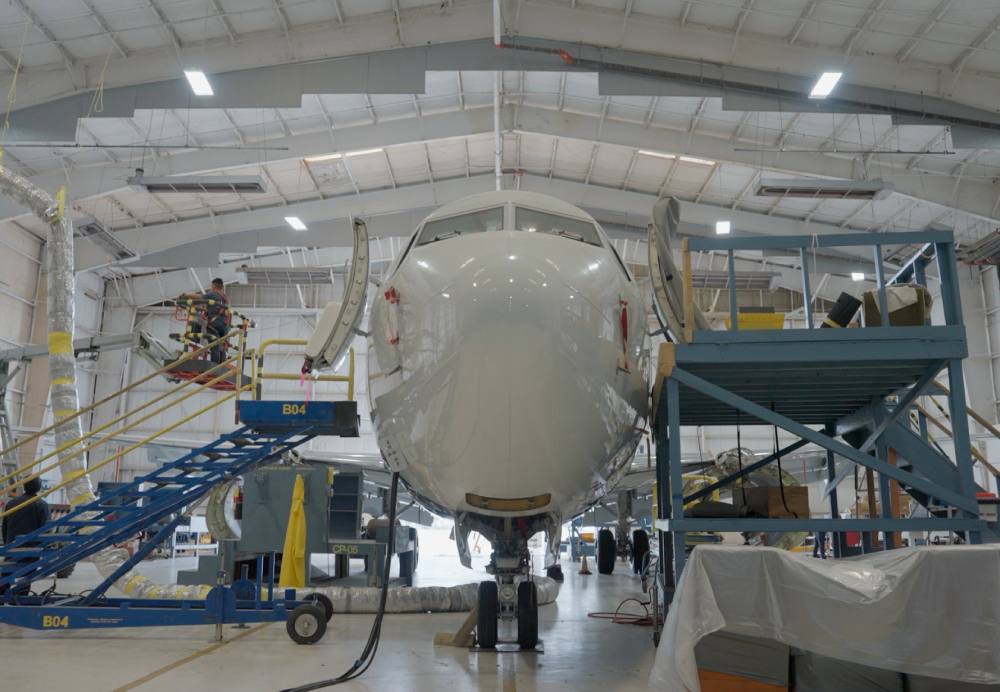
During major “C” and “D” checks — which can range from six weeks to nearly a year — operators look for opportunities to replace outdated components, modernize aircraft interiors, and reduce turnaround time. For VIP and special-mission aircraft, these upgrades frequently involve custom, low-volume interior parts that are no longer manufactured. Legacy lighting systems, specialized fittings, and cabin panels often come with months-long lead times, especially when OEM parts have been discontinued.
This is where Spectrum Networks creates real value. Leveraging industrial 3D printing and Continuous Fiber Reinforcement (CFR), the company rapidly designs and manufactures flight-ready aircraft components that meet stringent aerospace standards — without the delays or high costs of traditional manufacturing.
From Obsolete Lighting to Flight-Ready Solutions
Spectrum Networks collaborates closely with ALOFT AeroArchitects, a respected completion and maintenance provider for VIP and special-mission aircraft. Spectrum engineers and produces certified 3D-printed components, while ALOFT handles installation and certification during scheduled maintenance. Together, they provide a seamless solution that helps operators upgrade aging fleets faster and more efficiently.
One of the most common challenges they tackle is replacing outdated halogen lighting with modern, energy-efficient LED systems.
The issue? Many existing aircraft ceiling panels were designed 15-20 years ago, long before today's LED fixtures existed. Retrofitting required reworking hundreds of mounting holes — a time-consuming and costly process.
Spectrum solved this by engineering a custom drop-in LED replacement, created using Markforged's FX10 industrial 3D printer. These components replicate the original form, fit, and function, enabling technicians to install them directly into existing panels without modifying the aircraft's certified structure.
“Before 3D printing, part availability for lights could take anywhere from three to six months,” says Colby Hall, Director of Technology, ALOFT AeroArchitects. “Now, we can deliver complete sets in just a few weeks.”
Quality, Traceability, and Engineering Precision
In aviation, verification is everything. Every part must match its engineering drawing, and often proof of conformance must be documented.
Markforged's FX10 supports this need through built-in quality assurance. A laser micrometer inspects each printed layer, generating a digital conformance report that verifies the part meets specifications.
“For the FAA, that's a big deal,” says Neil Gunnarson, President & COO of Spectrum Networks, “You can't cut open every part to check it. The inspection data gives us objective proof that the part meets the requirements.”
In 2024 alone, Spectrum manufactured more than 10,000 certified 3D-printed aircraft parts now flying worldwide — demonstrating how industrial additive manufacturing can consistently meet aerospace-grade requirements.
Built for Strength, Speed, and Aesthetic Quality
Spectrum relies on Onyx thermoplastic combined with continuous fiber reinforcement to produce components that are lightweight, durable, and structurally capable of real-world aircraft loads.
Markforged's high surface quality also allows most parts to ship directly off the printer, eliminating sanding and finishing. This efficiency helps Spectrum scale production while delivering premium-quality parts suited for VIP, government, and head-of-state aircraft.
Distributed Manufacturing: The Future of Aviation MRO
The Spectrum-ALOFT partnership reflects a major shift in aviation maintenance. Instead of waiting months for legacy components, MRO teams can now produce certified parts on demand through distributed additive manufacturing.
This approach reduces downtime, extends aircraft service life, and enables rapid modernization — all while maintaining strict airworthiness and traceability standards.
As 3D-printed components become more embedded in aviation workflows, they are proving essential for MRO teams that require speed, precision, repeatability, and safety.
A Future-Ready Path for Aerospace Manufacturing
With fleets aging and obsolescence increasing, additive manufacturing is becoming a critical tool for aviation MRO. Platforms like the Markforged FX10 allow aerospace suppliers to respond quickly, manufacture certified components with built-in quality assurance, and keep aircraft flying longer.
“It's good to use equipment that's designed for the future,” Gunnarson concludes. “That benefits everybody involved.”
Download the Free Report on How COVID-19 has Impacted Supply Chains
Gain key insights including: COVID-19 pandemic impact on business. 3D printing use during the health pandemic. Challenges facing manufacturers using incumbent technology. Future plans for investing in additive manufacturing. And more...
Get the report