Aerospace Additive Manufacturing in Orbit: Building a 3D Printed Satellite for Flight
For decades, aerospace manufacturing followed a familiar path, machined metals like aluminum and titanium, carefully assembled components, and long production cycles designed to eliminate risk. Reliability came first, even if it meant sacrificing speed.
But today, that model is shifting. Additive manufacturing is no longer confined to prototyping labs, it’s operating in orbit.
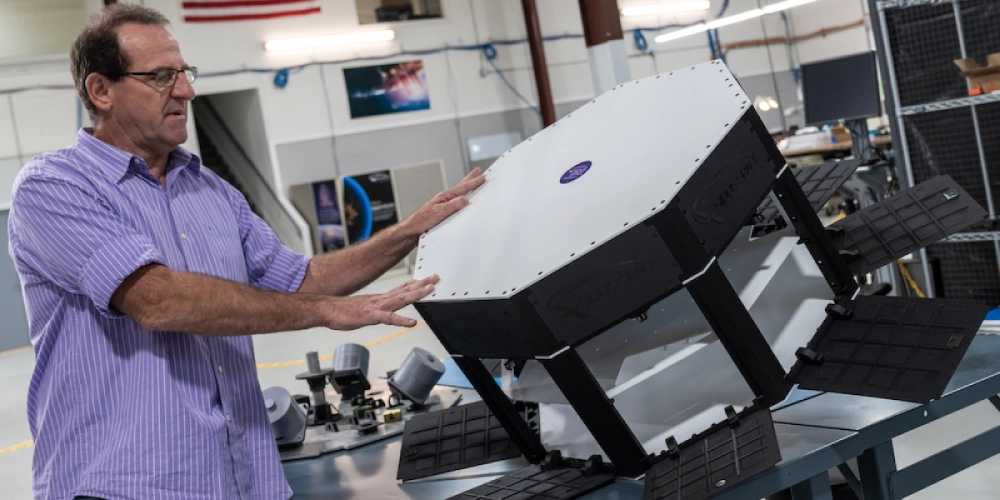
That shift became tangible when Tony Boschi and the team at Sidus Space developed LizzieSat, a satellite partially built using 3D printing and launched aboard SpaceX’s Transporter-9 mission.
What this mission demonstrated is clear: aerospace additive manufacturing has moved beyond experimentation, it is now a practical, flight-ready solution.
Designing Within a 100 kg Constraint
LizzieSat was engineered under a strict requirement: total mass under 100 kilograms. In aerospace terms, that constraint defines everything.
Every subsystem—power, avionics, payload—consumes weight. Structural components often become the only place left to optimize. Yet those same structures must endure extreme conditions:
- Launch forces reaching multiple Gs
- Harsh solar radiation.
- Temperature swings nearing 200°C.
- • Years of orbital exposure.
Under these conditions, even small components experience amplified loads. A lightweight part can effectively weigh five times more during launch.
The challenge for Sidus Space wasn’t just reducing weight—it was building a flexible satellite platform capable of supporting multiple missions. That required a structure that was not only strong and lightweight, but also adaptable and quick to iterate. Traditional manufacturing simply couldn’t keep pace.
How Additive Manufacturing Changed the Process
With conventional machining, even minor design updates can delay production—new drawings, retooling, and reassembly all add time.
WhUsing the Markforged X7, Sidus Space adopted continuous carbon fiber reinforcement to produce structural components. These weren’t prototypes—they were flight hardware.
The advantages were immediate:
- Strength comparable to metal with significantly lower weight
- Freedom to design complex geometries
- Rapid iteration cycles
Instead of waiting weeks for updated parts, engineers could redesign, print, and integrate components within a day. That shift transforms how aerospace programs operate—turning iteration into a continuous process rather than a bottleneck.
Can 3D Printed Parts Survive Space?
One of the biggest questions around additive manufacturing is durability—especially in space.
To answer this, Sidus Space conducted real-world testing aboard the International Space Station. Components made from Onyx material were exposed to the space environment.
Originally planned for 15 weeks, the test extended to a full year. During that time, materials endured:
- Constant solar radiation
- Extreme temperature cycling
- Vacuum exposure
When the parts returned, many materials showed degradation. The Onyx components did not. They retained structural integrity with no measurable difference from newly printed parts.
This wasn’t theoretical validation—it was proof that properly engineered 3D printed composites can survive in orbit.
With multiple LizzieSats now operational since 2024, additive manufacturing has progressed from testing to deployment.
Rethinking Structure: Eliminating Fasteners
One of the less obvious contributors to satellite weight is hardware, especially fasteners.
Sidus engineers approached this differently. Instead of adding screws and bolts, they designed interlocking features directly into the printed components. These precision-fit geometries allow parts to slide and lock into place with extremely tight tolerances.
This approach offers multiple advantages:
- Reduced overall mass
- Fewer failure points
- Simplified assembly
Such designs would be nearly impossible with traditional machining, but additive manufacturing makes them both feasible and repeatable.
It’s not just optimization, it’s a complete rethink of structural design.
Meeting Aerospace Standards: Fire Safety and Traceability
In aerospace, performance alone isn’t enough. Materials must meet strict compliance requirements.
Sidus addressed this by using advanced materials like Onyx FR-A, which combines fire resistance with full traceability.
This enables:
- Batch-level material tracking
- Root cause analysis in case of failure
- Alignment with aerospace certification standards
For engineering teams, this bridges a critical gap bringing additive manufacturing in line with regulatory and quality expectations.
From Prototype to Platform
LizzieSat isn’t just a demonstration—it’s a fully operational satellite designed for a five-year mission life.
More importantly, it represents a shift in how satellites are built. Instead of creating mission-specific hardware each time, Sidus developed a modular platform capable of adapting to different payloads and industries.
This scalability is essential in a fast-moving commercial space market, where speed and flexibility define competitiveness.
What This Means for Engineering Teams
LizzieSat changes the conversation around additive manufacturing. It’s no longer limited to prototyping or tooling—it’s enabling real, mission-critical hardware.
Aerospace 3D printing can now:
- Reduce structural weight
- Enable complex, previously unmanufacturable designs.
- Eliminate unnecessary hardware
- Accelerate development timelines
- Meet compliance and traceability requirements
- Perform reliably in space environments.
For engineering leaders, the question is no longer whether additive manufacturing works in aerospace.
Conclusion
Aerospace manufacturing is entering a new phase, one where speed, flexibility, and performance are no longer trade-offs but expectations. LizzieSat stands as a clear example of how additive manufacturing is reshaping what’s possible, turning complex design challenges into opportunities for innovation. By enabling lighter structures, faster iteration, and flight-ready performance, 3D printing is no longer a support tool, it’s becoming a core part of aerospace production. For engineering leaders and manufacturers, the shift is already underway. Those who embrace it early will not only move faster but build smarter, more adaptable systems for the future of space.
Download the Free Report on How COVID-19 has Impacted Supply Chains
Gain key insights including: COVID-19 pandemic impact on business. 3D printing use during the health pandemic. Challenges facing manufacturers using incumbent technology. Future plans for investing in additive manufacturing. And more...
Get the report