How Automotive Additive Manufacturing Accelerates High-End Fabrication
Engineering insights from inside one of America's most advanced performance workshops
For decades, elite automotive fabrication has been built on skill, precision, and hands-on problem solving. Every high-performance build demands exact tolerances, flawless execution, and the ability to adapt when parts or designs don't quite cooperate. As modern supercars become more complex and customer expectations continue to rise, traditional fabrication methods can begin to slow even the most capable shops. Long lead times for fixtures, intricate exhaust layouts, and limited availability of specialized components often create unnecessary delays.
This is where automotive additive manufacturing is quietly transforming the way high-end fabrication gets done.
At Graham Rahal Performance (GRP), a performance shop known for working on some of the world's most exclusive vehicles, 3D printing has become a core part of the engineering and fabrication process. From rare Ferraris and McLarens to limited-production Lamborghinis, GRP operates in an environment where accuracy, consistency, and repeatability are essential. There is little room for trial and error when each vehicle represents a significant investment.
What once required weeks of manual fabrication can now be completed in a matter of hours through a blend of composite and metal additive manufacturing. The result is faster development, cleaner execution, and more predictable outcomes.
Cutting Fabrication Time Without Compromising Quality
Before integrating additive manufacturing into its workflow, GRP's fabrication team routinely spent 20 to 40 hours hand-building jigs, fixtures, and complex exhaust components. Each part involved cutting, welding, reshaping, and refining until the geometry was just right. While effective, the process consumed valuable time and limited how quickly projects could move forward.
Today, those same fixtures are designed digitally, printed overnight, and ready for use the next day. There is no machining, no finishing work, and no rework.
As fabrication specialist Rob Sorum explains, the difference is immediate. Parts come off the printer ready to use, with precise fitment straight out of the build chamber. The shift has eliminated hundreds of hours of manual labor, allowing the team to focus on higher-value engineering tasks, faster turnaround times, and increased throughput without sacrificing craftsmanship.
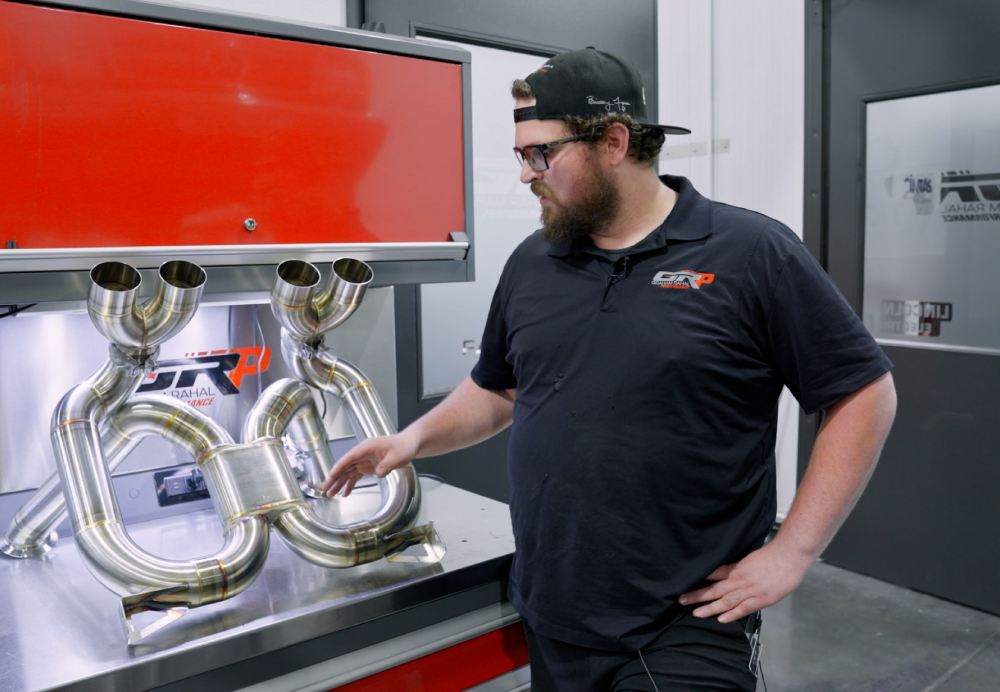
One of the most striking examples of this transformation came during work on the Lamborghini Revuelto, a 1,000-horsepower hybrid supercar with demanding exhaust requirements. The project called for a custom X-pipe designed to optimize exhaust flow and power delivery. The geometry was complex, and producing it through conventional fabrication would have meant extensive cutting, grinding, and repeated adjustments.
Instead, the team designed and printed custom 316L stainless steel flanges using an industrial metal 3D printer. The printed components delivered clean, weld-ready surfaces, precise geometry, and controlled internal structures that reduced weight without compromising strength. Post-processing was minimal, and the parts could be reproduced consistently across multiple builds.
Sorum admits he initially expected welding the printed steel to be challenging. In practice, the material performed exceptionally well, producing clean welds with consistent results. For a shop that values weld appearance as much as performance, this capability represented a major shift in what was possible.
More Than End-Use Parts: Improving the Entire Shop Workflow
While high-performance exhaust components tend to draw the most attention, GRP has found some of the biggest gains in everyday shop tooling. Additive manufacturing is now used to produce shock clamps that protect delicate suspension components, toe clamps for waterjet cutting that are strong yet gentle on expensive tooling, and assembly jigs that ensure repeatable results on recurring jobs.
Custom brackets, housings, and templates that once required milling or external vendors are now produced in-house on demand. Many of these tools are printed using composite materials reinforced with continuous fiber, offering strength comparable to aluminum while dramatically reducing production time and cost.
For fabrication teams evaluating the return on investment of automotive 3D printing, tooling often delivers the fastest and most tangible benefits. Faster tool production translates directly into smoother workflows and fewer bottlenecks on the shop floor.
Why Additive Manufacturing Fits High-End Automotive Fabrication
Across GRP's projects, several consistent advantages stand out. Additive manufacturing enables precision in complex geometries and critical alignments that are difficult or impossible to achieve through traditional methods. Speed is another defining factor, with many parts and fixtures produced in under 24 hours. Repeatability ensures consistent results across multiple vehicles, while lightweighting becomes achievable through optimized internal designs.
Perhaps most importantly, additive manufacturing offers design freedom that conventional machining cannot match. Complex shapes, internal channels, and customized geometries can be created without the constraints of traditional tooling.
For shops working on multimillion-dollar vehicles or managing high volumes of custom builds, these benefits quickly compound. Additive manufacturing does not replace craftsmanship; it enhances it by removing inefficiencies and expanding what skilled fabricators can accomplish.
Rethinking Modern Automotive Fabrication
Across the performance and automotive sectors, more engineering teams are reexamining how digital tools fit into their daily operations. As vehicle designs grow increasingly complex and turnaround expectations continue to tighten, additive manufacturing is proving to be a practical complement to machining and hand fabrication.
Shops investing in industrial 3D printers are often focused on eliminating common bottlenecks. Whether it's developing exhaust components with tighter tolerances, producing durable fixtures for repeated use, or iterating prototypes without outsourcing, additive technology offers flexibility that traditional workflows struggle to match. It is also opening the door to low-volume, high-value part production where precision and consistency are critical.
Every shop's workflow is different, but the broader direction of the industry is clear. Automotive additive manufacturing has moved well beyond prototyping. It is becoming a reliable, production-ready tool that supports speed, accuracy, and customization in modern high-end fabrication.
Download the Free Report on How COVID-19 has Impacted Supply Chains
Gain key insights including: COVID-19 pandemic impact on business. 3D printing use during the health pandemic. Challenges facing manufacturers using incumbent technology. Future plans for investing in additive manufacturing. And more...
Get the report