From eight days to two: 3D printing a custom jet dragster steering wheel
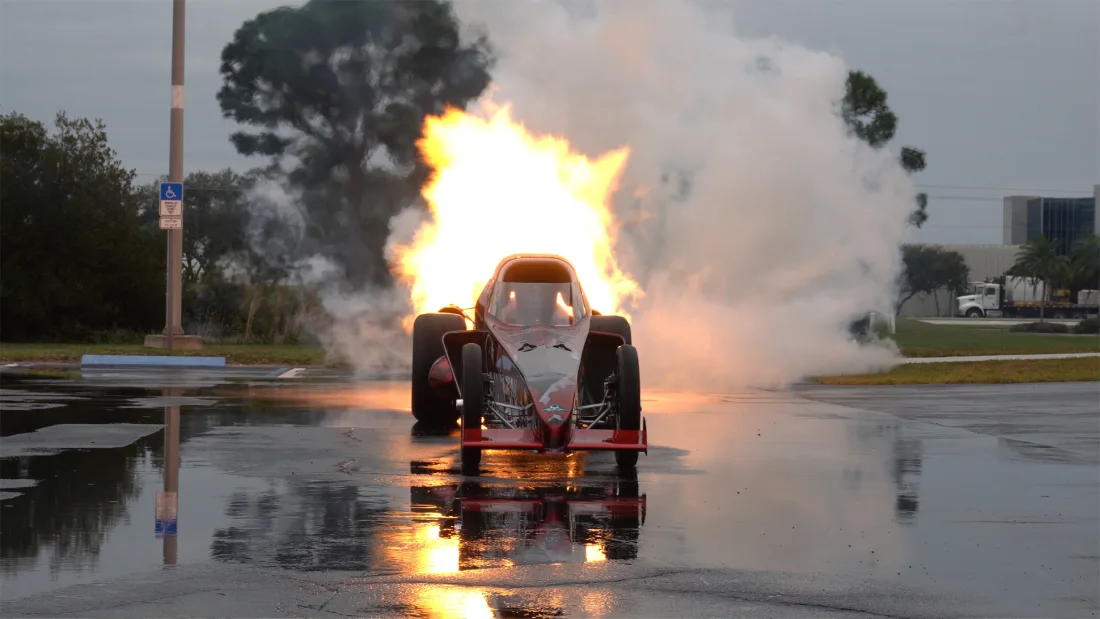
Jet dragster driver Josette Roach could grip her steering wheel, but she couldn’t reliably reach all the buttons she needed. The standard butterfly wheel placed those controls around an average hand size. In a car that covers a quarter mile in 5.5 seconds and reaches 280 mph, that mismatch mattered.
Larsen Motorsports used the Markforged X7 to build a steering wheel around Roach’s reach. The carbon fibre-reinforced wheel proved stiffer than the aluminium original in the team’s testing, and lead time fell from eight days to two.
Designing for one driver
The team needed just one wheel. Ordering a standard aluminium model meant waiting for delivery and then modifying it. Commissioning a custom CNC-machined wheel would give the team more control over the fit, but the grips, button holes and top plates would still require several machining and assembly operations.
With 3D printing, the engineers could design the grip shape and button positions together. Roach’s reach became the starting point for the wheel, and the team could address a separate question in the same design: where did the wheel need reinforcement to resist twisting?
Placing carbon fibre where the wheel carried load
Larsen Motorsports printed the wheel on the Markforged X7 using Onyx, a nylon material containing chopped carbon fibre. During printing, the X7 also laid continuous strands of carbon fibre along selected paths inside the part. The distinction mattered for the steering wheel. The short fibres were distributed throughout the nylon, while the engineers could direct the continuous strands through areas such as the centre section, which had to resist twisting as Roach turned the wheel.
The team used Markforged Simulation to compare fibre layouts and predict how each design would respond under load before committing to a print. They then tested the finished wheel. Under the team’s test conditions, the aluminium wheel flexed while the printed composite wheel showed no visible flex.
What a six-day saving means for low-volume production
For Larsen Motorsports, the 75% reduction in lead time applied to a finished, driver-specific component. The team could make a wheel with the controls in the right positions and have it ready in two days.
The same design questions apply to a one-off assembly fixture, a machine bracket with an awkward mounting position or a replacement handle sized for a particular operator. Which dimensions are fixed by the machine or the person using it? Where does the part carry load? Once a team has tested a design for its intended use, it can retain the print file and produce a replacement when needed.
Explore composite 3D printing with Chemtron
Have a machined part that takes days to source or needs modifying every time it arrives? Bring a drawing or sample to Chemtron. Our team works with manufacturers in Singapore and Malaysia to explore Markforged composite 3D printing. Tell us what the part needs to fit, what forces it sees in service and how long it takes to make today.
Discuss your application with Chemtron