Scaling UAV Manufacturing with 3D Printed Drone Parts at Gamma Rotors
How in-house additive manufacturing enables faster development, lighter structures, and stronger IP control
Unmanned aerial vehicles are advancing at a remarkable pace. As drones move beyond basic observation into complex missions such as logistics, inspection, and defense-related operations, the performance expectations placed on their components have increased significantly. Strength, weight optimization, reliability, and speed of development now play a decisive role in how effectively a UAV platform performs in real-world conditions.
To meet these evolving demands, manufacturers are increasingly turning to 3D printed drone parts as a practical and scalable solution rather than relying solely on conventional manufacturing methods.
Gamma Rotors, an India-based UAV manufacturer, is one such example. What began as an internal prototyping initiative has evolved into a fully integrated additive manufacturing operation. Today, 3D printing is embedded into the company’s production strategy, helping Gamma Rotors accelerate innovation, reduce dependence on machining, and safeguard proprietary design data.
Moving Beyond Prototyping to Functional Drone Components
Gamma Rotors first adopted additive manufacturing to shorten prototyping cycles and explore alternative materials. Earlystage printing allowed the engineering team to rapidly evaluate form, fit, and performance without involving external vendors. This internal capability proved especially valuable during frequent design iterations, where speed and flexibility were essential.
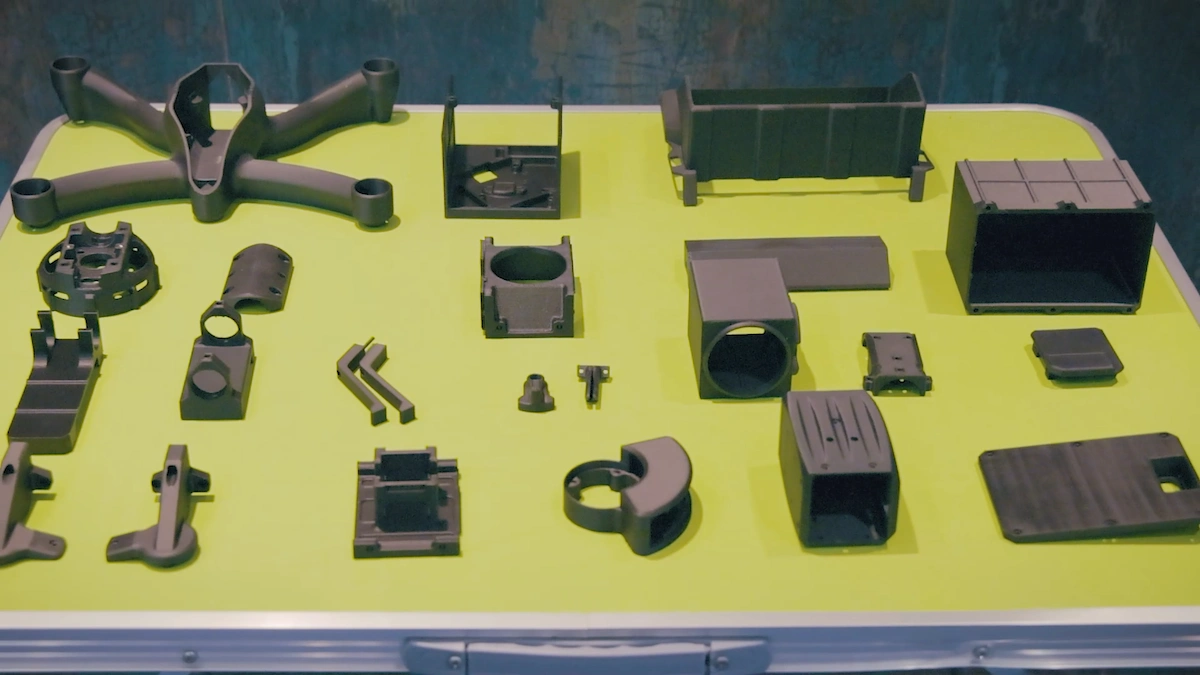
Over time, confidence in both the technology and printed materials grew. After extensive testing and continuous operation across design and engineering teams, the company expanded into a dedicated internal print farm. With multiple composite 3D printers running in parallel, Gamma Rotors now produces end-use 3D printed drone parts alongside prototypes.
This shift reflects a broader change across the UAV industry. Additive manufacturing is no longer limited to concept validation. It is increasingly being used for low- to mid-volume production where rapid iteration, customization, and responsiveness outweigh the benefits of traditional mass manufacturing.
Achieving Strength and Weight Efficiency Through 3D Printing
Drone components must endure constant vibration, aerodynamic loads, and environmental exposure, all while remaining lightweight to maximize flight time and payload capacity. Traditionally, achieving this balance required machining aluminum or titanium parts, processes that are both time-intensive and costly.
By using continuous carbon fiber–reinforced composite materials, Gamma Rotors has replaced several metal components with 3D printed drone parts that offer comparable structural strength at a significantly reduced weight. This transition has enabled the team to reduce overall airframe mass, speed up part production, and adapt designs quickly as mission requirements change.
For UAV platforms, these benefits translate directly into improved endurance, greater payload flexibility, and faster development cycles from design to flight testing.
Protecting Drone IP with In-House Additive Manufacturing
Intellectual property protection is a critical concern in drone manufacturing. Outsourcing component production often requires sharing sensitive CAD files and design specifications with external suppliers, increasing the risk of data exposure and slowing down development timelines.
By keeping the production of 3D printed drone parts entirely in-house, Gamma Rotors retains complete control over its designs. Engineers can modify components, print updated versions, and test them immediately without transferring files outside the organization. This approach not only enhances security but also strengthens collaboration between design and manufacturing teams, resulting in faster feedback and higher-quality outcomes.
Across aerospace and defense-adjacent sectors, this focus on secure, internally managed additive manufacturing is becoming increasingly important. Regulatory developments are reinforcing the idea that additive manufacturing systems should be treated as critical infrastructure, emphasizing controlled software environments, traceable production, and protected data flows for sensitive applications.
Consistency and Reliability at Production Scale
As additive manufacturing transitions into production, consistency becomes just as important as speed. Gamma Rotors places strong emphasis on repeatability and process stability to ensure that printed parts perform reliably across multiple builds.
With validated materials, standardized workflows, and predictable output, 3D printing has become a dependable production tool rather than an experimental capability. This reliability is essential when manufacturing components destined for operational UAV systems, where performance consistency directly impacts safety and mission success.
The Expanding Role of 3D Printed Drone Parts in UAV Development
Gamma Rotors’ journey illustrates how additive manufacturing is reshaping UAV production across the industry. By integrating 3D printing into core workflows, manufacturers can shorten development cycles, produce lightweight structural components, iterate designs rapidly, reduce reliance on external machining, and protect sensitive intellectual property.
For teams building next-generation UAV platforms, 3D printed drone parts are no longer a niche solution. Additive manufacturing is increasingly viewed as foundational production infrastructure, supporting innovation, scalability, and resilience in an increasingly competitive UAV landscape.
Download the Free Report on How COVID-19 has Impacted Supply Chains
Gain key insights including: COVID-19 pandemic impact on business. 3D printing use during the health pandemic. Challenges facing manufacturers using incumbent technology. Future plans for investing in additive manufacturing. And more...
Get the report